

The second quarter came to a close and brought us into the second half of the year. Every year I write this, it feels too soon! Equity markets closed the month of June strong with the S&P 500 up 15.20% for the quarter. Technology was far-and-away the sector winner for the last 3 months, climbing 33.2% thanks to the AI buildout and adoption still very much at the forefront.
Performance for international markets remained strong throughout the 2nd quarter as well. Developed markets increased just under 11% while emerging markets were up over 24%. Fixed income performance on the other hand remained fairly muted. The yield curve rose marginally across maturities, providing a headwind for total return. However, with yields still strong, the interest earned helped push the US Aggregate bond index up for the quarter 0.67%.
Artificial Intelligence, AI, has been a consistent and constant theme in 2026 and we don’t anticipate it changing anytime soon. Nationwide Economics recently published an article on U.S. investment super-cycles and made the case that “it [AI] has already demonstrated the potential to become a long-lasting investment super-cycle.”
What exactly is an investment super-cycle? Nationwide’s economists define it simply: a period of sustained investment and economic growth, driven by a technology significant enough to lift productivity across the entire economy, not just the industry building it. That last part is important, and I’ll come back to it.
Super-cycles aren’t a new phenomenon. The U.S. has been through this before. Railroads in the late 1800s. Electrification in the early 1900s. The defense and aerospace buildout after World War II. Telecom and IT in the late 90s. Shale energy in the 2010s. Each one saw investors pour enormous capital into a single theme, and each one changed how the economy functioned once the dust settled.
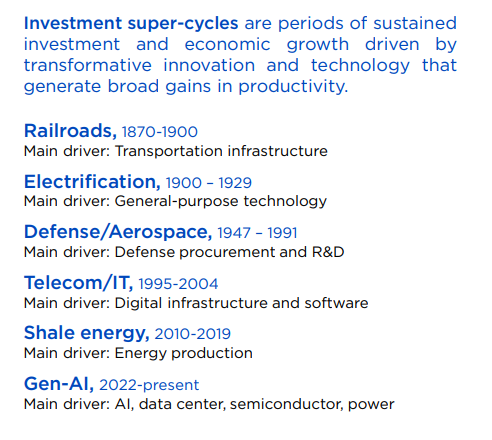
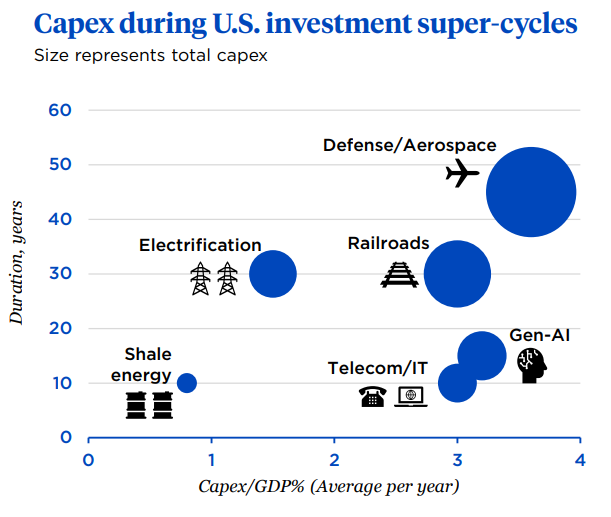
The chart above is a useful reference point. Circle size represents total capital spending, and it shows Gen-AI already keeping company with Electrification and Railroads despite still being early in its cycle. Defense/Aerospace remains the heavyweight of the group, both in capex and duration, but it didn’t produce the biggest productivity gains. Telecom/IT did, on far less spending. The amount of money poured into a cycle hasn’t historically been what determined its payoff. How that investment gets used across the broader economy has.
There’s a case Gen-AI could earn a spot on that list, but Nationwide’s own research comes with a caveat worth sitting with: investment alone hasn’t historically been enough on its own. In the cycles that moved the needle on productivity, businesses tended to reorganize around the technology rather than simply purchasing it. Electricity is the clearest example. Factories didn’t see meaningful output gains the moment they plugged in. It took roughly three decades of redesigning the factory floor around electric power before productivity gains showed up broadly in the data. It wasn’t as simple as swapping a steam engine for an electric motor. It’s reasonable to think something similar could play out here, though there’s no guarantee the timeline or path looks similar. The hundreds of billions going into chips, data centers, and power generation is the easy part. In fact, we see new headlines about the next billion dollar investment every other day! Whether companies actually restructure how they operate around AI, not just with it, is what will decide whether this becomes a true super-cycle or just an expensive tech buildout.
An interesting story that could determine whether this cycle ends up disinflationary like Telecom/IT or inflationary like Defense/Aerospace, is what happens to the workers as a result of AI adoption. Done well, AI should make existing employees more productive by handling repetitive work and allowing people to focus on higher-value decisions. But if businesses view AI only as a cost-cutting tool, there’s a risk. Employees are also consumers. An economy can’t thrive indefinitely if purchasing power shrinks faster than productivity grows.
We’d also caution against assuming the current enthusiasm simply compounds in a straight line. Several prior cycles saw a phase where initial excitement ran ahead of the fundamentals, and the market needed time to catch-up, or correct. It wouldn’t necessarily mean the technology stops mattering. The early money tends to chase the early leaders, the chipmakers and data center builders, though could eventually broaden out toward the industries actually putting the technology to work. This could mean the areas of the market furthest removed from tech or those further out on the adoption curve.
The Generative-AI story is still being written, and markets are inherently difficult to predict with any precision. Nationwide’s own framing seems like a reasonable lens to view it through: the eventual impact may hinge less on how much gets spent on chips and data centers, and more on whether that spending translates into real reorganization across the rest of the economy.
IMPORTANT DISCLOSURE INFORMATION: Please remember that past performance is no guarantee of future results. Different types of investments involve varying degrees of risk, and there can be no assurance that the future performance of any specific investment, investment strategy, or product (including the investments and/or investment strategies recommended or undertaken by PDS Planning, Inc. [“PDS”]), or any non-investment related content, made reference to directly or indirectly in this blog will be profitable, equal any corresponding indicated historical performance level(s), be suitable for your portfolio or individual situation, or prove successful. Due to various factors, including changing market conditions and/or applicable laws, the content may no longer be reflective of current opinions or positions. Moreover, you should not assume that any discussion or information contained in this blog serves as the receipt of, or as a substitute for, personalized investment advice from PDS. To the extent that a reader has any questions regarding the applicability of any specific issue discussed above to his/her individual situation, he/she is encouraged to consult with the professional advisor of his/her choosing. PDS is neither a law firm nor a certified public accounting firm and no portion of the blog content should be construed as legal or accounting advice. A copy of the PDS’ current written disclosure Brochure discussing our advisory services and fees is available for review upon request or at www.pdsplanning.com. Please Note: PDS does not make any representations or warranties as to the accuracy, timeliness, suitability, completeness, or relevance of any information prepared by any unaffiliated third party, whether linked to PDS’ web site or blog or incorporated herein, and takes no responsibility for any such content. All such information is provided solely for convenience purposes only and all users thereof should be guided accordingly. Please Remember: If you are a PDS client, please contact PDS, in writing, if there are any changes in your personal/financial situation or investment objectives for the purpose of reviewing/evaluating/revising our previous recommendations and/or services, or if you would like to impose, add, or to modify any reasonable restrictions to our investment advisory services. Unless, and until, you notify us, in writing, to the contrary, we shall continue to provide services as we do currently. Please Also Remember to advise us if you have not been receiving account statements (at least quarterly) from the account custodian.