
Trump Accounts are a new type of tax-advantaged investment account created for children under 18, and they officially launched on July 4, 2026, the same day the country marked its 250th birthday. Eligible children born between 2025 and 2028 receive a $1,000 seed deposit from the federal government, and parents, grandparents, and even employers can contribute up to $5,000 a year on top of that. The funds grow in low-cost index funds until the child turns 18, at which point the account converts into a traditional IRA.
If you’re a parent or grandparent trying to figure out where a Trump Account fits next to tools like a 529 plan or a custodial account, you’re not alone. In this article, we’ll walk through how Trump Accounts work, who qualifies, what the real benefits and trade-offs are, and how to think about them as part of your broader financial plan.
What is a Trump Account?
Before diving into the details, it’s helpful to understand how Trump Accounts came to be. Originally introduced as part of the One Big Beautiful Bill Act (OBBBA), these accounts were created through federal tax legislation enacted in 2025 and became available for contributions beginning July 4, 2026. The program’s objective is to give eligible children a new tax-advantaged way to begin building wealth from an early age.
While the name has generated headlines, the more important conversation for families is understanding how these accounts work, who may qualify, and whether these accounts complement existing savings strategies such as UTMA/UGMA accounts, 529 plans, Roth IRAs, or other taxable investment accounts.
Who Is Eligible for a Trump Account?
Any child under age 18 with a valid Social Security number in the United States may have a Trump Account established on their behalf. Parents, grandparents, relatives, friends, employers, charitable organizations, and governmental entities may all contribute, subject to applicable rules and contribution limits.
One of the most notable features is the federal government’s one-time seed contribution of $1,000 available for U.S. citizen born children as an initial investment that can compound over many years. Children born between January 1, 2025, and December 31, 2028, are eligible for the seed contribution after an account is established, and older children may still open an account but won’t qualify for this federal contribution.
Families can establish an account through the official enrollment process, including IRS Form 4547 or online at trumpaccounts.gov facilitated by the U.S. Department of Treasury. During the enrollment process, individuals will be instructed to download the Trump Accounts app for ongoing viewing and management of investment accounts.
How Do Trump Accounts Work?
Trump Accounts are designed as long-term investment accounts for children. Contributions can be made by parents, family members, employers, and certain organizations, while eligible children may receive a one-time federal seed contribution. The assets are invested in diversified index funds during childhood and generally remain invested until the beneficiary reaches adulthood, when the account begins transitioning to traditional IRA treatment.
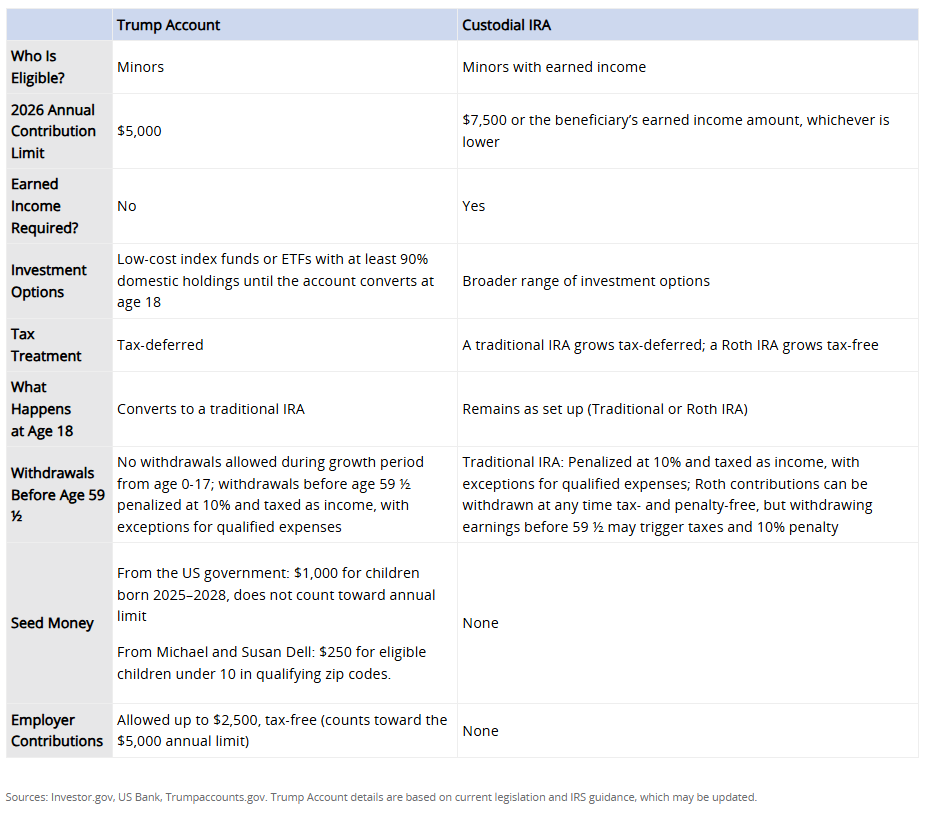
Trump Accounts function similarly to a traditional IRA in many ways, although they contain several unique rules while the beneficiary is still a minor. The dollars within each account are invested in diversified, low cost index mutual funds or ETFs during childhood, with investment restrictions relaxing once the child reaches age 18.
Key features include:
- Annual aggregated contribution limit of $5,000 per year (not including the $1,000 seed contribution)
- Contributions from family and friends are made on an after after-tax basis and are NOT tax deductible
- Employer contributions are limited to $2,500 per year, per employee and are tax deductible to the employer
- Investments grow tax-deferred while funds remain in the account
- Funds can be accessed without penalty when the child turns 18 for qualified expenses like education or a first home purchase
- Distributions if taken prior to age 59½ will also be assessed a 10% penalty (with similar exceptions as traditional IRAs)
- Regular withdrawals after age 59½ will be taxed at ordinary income rates
These features reinforce the program’s objective of encouraging investing from an early age and allowing decades of potential compound growth.
Trump Accounts and Roth IRA Conversion Opportunities
Once a child turns 18, Trump Account dollars are treated like a traditional IRA, therefore becoming eligible for conversions to a Roth IRA. This opens the door for a potentially valuable planning opportunity since Roth IRAs allow investments to grow and be withdrawn tax-free when requirements are met.
The timing of this conversion could be especially advantageous for many young adults who have just reached age 18. Early adulthood often comes with relatively low taxable income, allowing a conversion to occur at likely a lower tax cost. By converting sooner when the account has had less time to accumulate earnings, individuals may be able to minimize the immediate tax impact, potentially even at 0%, while preserving decades of tax-free growth.
A Trump Account provides a unique opportunity to establish a larger Roth IRA balance earlier in life than would typically be possible. Under current rules, most individuals cannot begin contributing meaningfully to a Roth IRA until they have earned income. While certain strategies, such as converting unused 529 plan funds into a Roth IRA, can provide a similar opportunity, Trump Accounts could create another pathway to building Roth assets before adulthood. This may allow young adults to enter their working years with a significant Roth IRA bucket with years of tax-free growth ahead.
How Trump Accounts Compare to Other Savings Strategies
Like many financial planning decisions, the answer depends largely on your family’s goals.
For some, a Trump Account may be an attractive way to begin investing early, particularly for children eligible for the $1,000 federal seed contribution which appears to be a no-brainer. Starting with an initial balance and allowing decades of compounded growth can create meaningful long-term value.
However, it’s important to remember that Trump Accounts are not necessarily a replacement for other, more established savings vehicles.
For example:
- Families prioritizing college savings may still benefit most from a 529 plan, which offers tax-free withdrawals for qualified education expenses.
- Teens with earned income may still find a Roth IRA to be one of the most powerful retirement savings tools available.
- Families seeking maximum flexibility may continue using taxable brokerage accounts, especially when funds may be needed before adulthood.
Instead of viewing these options as competitors, many households may find they serve different purposes within their comprehensive financial plan.
As always, contribution priorities should reflect your overall financial situation and consider other long-term goals.
Frequently Asked Questions About Trump Accounts
A Trump Account is a tax-advantaged investment account established for the benefit of a child under age 18. Contributions can be made by parents, grandparents, employers, charitable organizations, and other eligible contributors, subject to annual contribution limits. The account is designed to help children begin building long-term wealth through investments in diversified, low-cost index funds.
Generally, children under age 18 with a valid Social Security number may have a Trump Account established on their behalf. Children born between January 1, 2025, and December 31, 2028, may also qualify for a one-time $1,000 federal seed contribution if all eligibility requirements are met.
Family members and other eligible contributors can contribute to an aggregate annual limit of $5,000 per child, excluding the federal seed contribution. Certain employer contributions may also be permitted, subject to applicable rules and limitations.
No. Contributions made by parents, grandparents, and other individuals are generally made with after-tax dollars and are not tax deductible. However, investments within the account can grow on a tax-deferred basis while funds remain invested.
During childhood, Trump Accounts are generally limited to diversified, low-cost mutual funds or exchange-traded funds (ETFs) that track broad market indexes. These investment restrictions are intended to promote long-term investing and broad diversification.
Under current guidance, a Trump Account generally begins transitioning to traditional IRA treatment once the beneficiary reaches adulthood. At that point, withdrawal and tax rules are generally governed by the rules applicable to traditional IRAs.
Depending on future IRS guidance and an individual’s circumstances, a Roth conversion may be possible once the account becomes subject to traditional IRA rules. Because tax consequences can vary significantly, individuals should consult a qualified tax professional or financial advisor before pursuing a conversion strategy.
Not necessarily. A Trump Account and a 529 plan serve different purposes. A 529 plan is specifically designed for education expenses and offers tax-free withdrawals for qualified education costs, while a Trump Account is intended as a long-term investment vehicle for a child’s future. The right choice depends on a family’s goals and overall financial plan.
Each option has advantages and trade-offs. Families focused on education savings may prioritize a 529 plan, teenagers with earned income may benefit from a Roth IRA, and those seeking greater flexibility may prefer a taxable brokerage account. In many cases, multiple account types can work together as part of a comprehensive financial strategy.
Summary and Our Thoughts on Trump Accounts
Trump Accounts add a new option for families looking to invest on behalf of children and grandchildren. The combination of tax-deferred growth, a long investment horizon, and the potential $1,000 federal seed contribution for eligible children makes them a noteworthy addition to the financial planning landscape.
That said, a Trump Account is not automatically the best place to save every dollar. Like 529 plans, Roth IRAs, and taxable investment accounts, it serves a specific purpose and should be evaluated within the context of your broader financial goals. Factors such as education funding needs, retirement objectives, tax considerations, and liquidity requirements can all influence where a Trump Account fits within your overall strategy.
For many families, the question may not be whether to use a Trump Account or another savings vehicle, but rather how these tools can work together to support multiple goals over time. Taking a coordinated approach can help ensure you’re maximizing available opportunities while staying aligned with your long-term financial plan.
IMPORTANT DISCLOSURE INFORMATION: Please remember that past performance is no guarantee of future results. Different types of investments involve varying degrees of risk, and there can be no assurance that the future performance of any specific investment, investment strategy, or product (including the investments and/or investment strategies recommended or undertaken by PDS Planning, Inc. [“PDS”]), or any non-investment related content, made reference to directly or indirectly in this blog will be profitable, equal any corresponding indicated historical performance level(s), be suitable for your portfolio or individual situation, or prove successful. Due to various factors, including changing market conditions and/or applicable laws, the content may no longer be reflective of current opinions or positions. Moreover, you should not assume that any discussion or information contained in this blog serves as the receipt of, or as a substitute for, personalized investment advice from PDS. To the extent that a reader has any questions regarding the applicability of any specific issue discussed above to his/her individual situation, he/she is encouraged to consult with the professional advisor of his/her choosing. PDS is neither a law firm nor a certified public accounting firm and no portion of the blog content should be construed as legal or accounting advice. A copy of the PDS’ current written disclosure Brochure discussing our advisory services and fees is available for review upon request or at www.pdsplanning.com. Please Note: PDS does not make any representations or warranties as to the accuracy, timeliness, suitability, completeness, or relevance of any information prepared by any unaffiliated third party, whether linked to PDS’ web site or blog or incorporated herein, and takes no responsibility for any such content. All such information is provided solely for convenience purposes only and all users thereof should be guided accordingly. Please Remember: If you are a PDS client, please contact PDS, in writing, if there are any changes in your personal/financial situation or investment objectives for the purpose of reviewing/evaluating/revising our previous recommendations and/or services, or if you would like to impose, add, or to modify any reasonable restrictions to our investment advisory services. Unless, and until, you notify us, in writing, to the contrary, we shall continue to provide services as we do currently. Please Also Remember to advise us if you have not been receiving account statements (at least quarterly) from the account custodian.