Volatility remains in vogue to begin the month of April. The war in Iran continues to change shape with the U.S. blockade of the Strait of Hormuz just underway after peace talks fell through. And by the time you read this, it may already be old news. Traders are watching every headline, trying to determine what it means for futures and whether they need to buy or sell. It has felt like one of the most hectic years for the market in recent memory. But before drawing that conclusion, it pays to check your recency bias at the door and remember the importance of perspective.
One Year Ago — April 13th, 2025
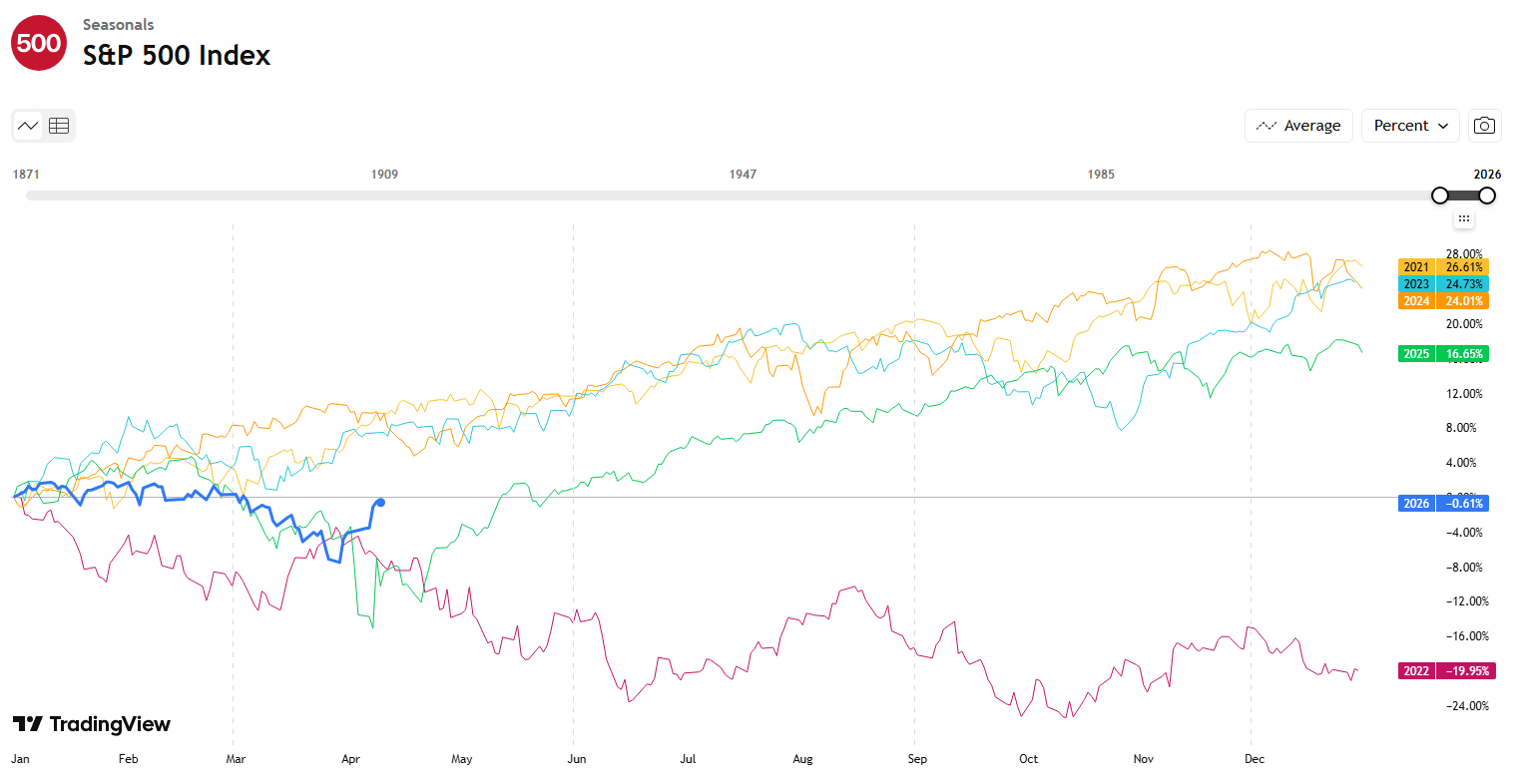
Tariffs were in full swing following the April 2nd “Liberation Day” announcement. Within a week they were paused for negotiations, but not before the 10% baseline floor took hold across nearly every trading partner. The consensus view was grim: persistent upward pressure on inflation, rising business expenses, and a squeeze on both consumers and suppliers. The S&P 500 is down roughly -10% on the year. It would go on to finish the year up +16.65%.
Today — April 13th, 2026
The United States is now directly engaged in a war with Iran that carries potentially long-lasting consequences for energy prices, inflation, and U.S. budget priorities. Oil prices swung from $70 to $120 and back to $100 a barrel in the span of a single month. Europe, China, and Russia are beginning to feel the supply shock created by the closure of the Strait of Hormuz. Ceasefire agreements have been proposed, agreed to, and promptly fell through. Will the market recover? If so, how!? The S&P 500 is down just -1% year to date.
In hindsight, things have a way of coming into focus. In 2025, tariffs ultimately proved less severe than feared, inflation ticked up only modestly, and the market rewarded those who stayed the course. Even 2022, when both stocks and bonds fell together, makes sense in retrospect. The fastest Fed tightening cycle in decades collided with pandemic-era excess. What followed were three consecutive years of gains: +24%, +24%, and +16.65%. The difficult years happened. So did the recoveries.
The Chart Above Tells the Story
The seasonal chart above plots the S&P 500’s year-to-date performance for each of the past several years. Notice where 2026 (blue line) sits right now, just below zero. Then look at where those same lines ultimately traveled by December.
This is the nature of markets: bad news arrives suddenly, forcefully, and without warning. It resets expectations overnight and sends headlines into a frenzy. Good news, by contrast, tends to be quiet. It’s the slow accumulation of corporate earnings, innovation, and resilience that doesn’t announce itself. It accrues, day after day, until you look up at year-end and realize the worst moments of the year are barely visible on the chart.
The only year on this chart that ended in significantly negative territory was 2022. A historically unusual year in which rising interest rates punished both stocks and bonds simultaneously. Even then, the investors who stayed the course were rewarded in each of the three years that followed.
It is difficult to maintain perspective when geopolitical crises are unfolding in real time and the financial media is calibrated to amplify every swing. That difficulty is not a character flaw, just a human response. But it’s why having a long-term financial plan matters. A plan doesn’t eliminate volatility. It gives you something sturdy to stand on while the volatility passes.
IMPORTANT DISCLOSURE INFORMATION: Please remember that past performance is no guarantee of future results. Different types of investments involve varying degrees of risk, and there can be no assurance that the future performance of any specific investment, investment strategy, or product (including the investments and/or investment strategies recommended or undertaken by PDS Planning, Inc. [“PDS”]), or any non-investment related content, made reference to directly or indirectly in this blog will be profitable, equal any corresponding indicated historical performance level(s), be suitable for your portfolio or individual situation, or prove successful. Due to various factors, including changing market conditions and/or applicable laws, the content may no longer be reflective of current opinions or positions. Moreover, you should not assume that any discussion or information contained in this blog serves as the receipt of, or as a substitute for, personalized investment advice from PDS. To the extent that a reader has any questions regarding the applicability of any specific issue discussed above to his/her individual situation, he/she is encouraged to consult with the professional advisor of his/her choosing. PDS is neither a law firm nor a certified public accounting firm and no portion of the blog content should be construed as legal or accounting advice. A copy of the PDS’ current written disclosure Brochure discussing our advisory services and fees is available for review upon request or at www.pdsplanning.com. Please Note: PDS does not make any representations or warranties as to the accuracy, timeliness, suitability, completeness, or relevance of any information prepared by any unaffiliated third party, whether linked to PDS’ web site or blog or incorporated herein, and takes no responsibility for any such content. All such information is provided solely for convenience purposes only and all users thereof should be guided accordingly. Please Remember: If you are a PDS client, please contact PDS, in writing, if there are any changes in your personal/financial situation or investment objectives for the purpose of reviewing/evaluating/revising our previous recommendations and/or services, or if you would like to impose, add, or to modify any reasonable restrictions to our investment advisory services. Unless, and until, you notify us, in writing, to the contrary, we shall continue to provide services as we do currently. Please Also Remember to advise us if you have not been receiving account statements (at least quarterly) from the account custodian.