As war in the Middle East escalates, investors are confronted with the reality of a world that is becoming more dangerous. With markets reacting minute by minute to the news, it’s helpful to take a step back and consider events in a broader context, suggests Capital Group political economist, Talha Khan.
“The death of Iran’s Supreme Leader Ayatollah Ali Khamenei marks a significant escalation in the long-running conflict between the United States, Israel and Iran. U.S. and Israeli military attacks targeting senior Iranian leadership represent a direct strike at regime command, rather than the type of limited infrastructure campaign we’ve seen in the past. Iran has responded with missile and drone attacks against Israeli territory, U.S. military bases and adjacent countries.
In financial markets, initial reactions reflected shock and uncertainty but not panic selling. Gold prices jumped and the U.S. dollar rose as investors sought safe-haven hedges. Oil prices moved significantly higher as traders worried about supply disruptions. But global equity and fixed income markets were more subdued amid expectations that U.S. military action may be short lived.
For now, markets are adjusting to higher geopolitical risk but not yet positioned for a prolonged regional war. Whether that happens will depend on three pivotal events: the severity of Iran’s retaliation, the security of oil flows through the Strait of Hormuz and, ultimately, the outcome of the Iranian leadership succession.”
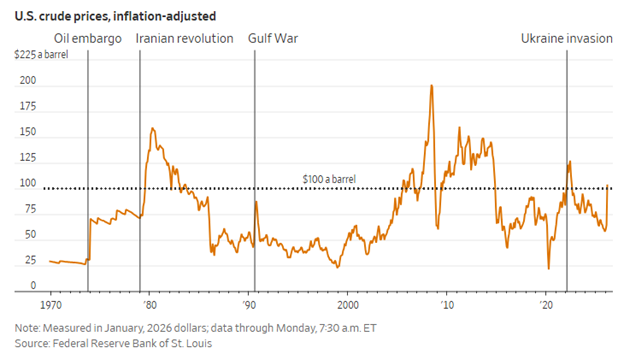
Oil has been in the forefront as prices spiked over 75% to over $100 per barrel.
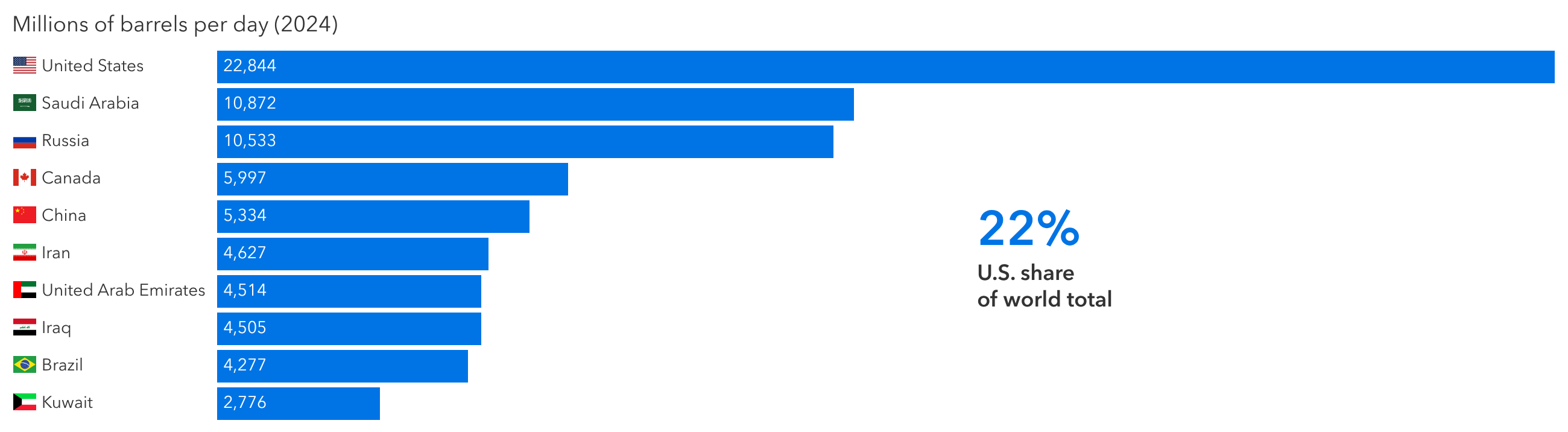
If the administration can keep the duration of this conflict to a few weeks, most economists are projecting oil prices to revert back to pre-invasion levels. But the real risk is if this escalates into a longer drawn-out war with a longer-term blockage of the Strait of Hormuz. Oil and LNG prices would jump ever further and cause a real strain on the global economy, resulting in higher inflation. Fortunately, the United States has shifted to the world’s largest producer of oil the past few years to leave us much less reliant on Middle Eastern oil. US oil companies will actually benefit from higher prices, but consumers will feel it at the pump until tankers start moving through the Strait of Hormuz.
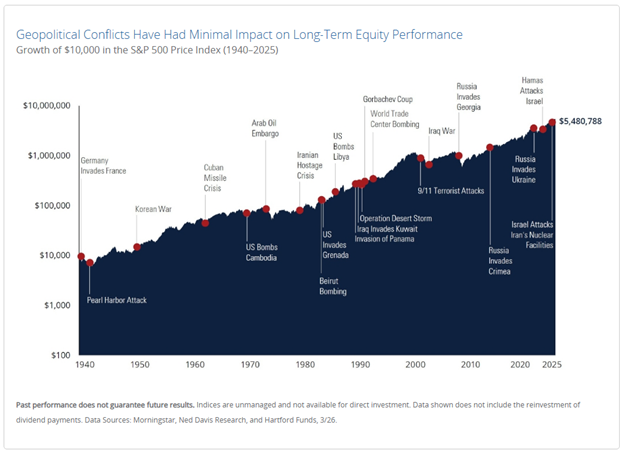
Markets will continue to react to this ever-changing event, but we urge investors to step back and focus on the long-term. We’ve lived through numerous geopolitical events where volatility and significant concerns spike, but markets seem to always weather the storm. We urge investors to remain diversified and not overreact to these events.
IMPORTANT DISCLOSURE INFORMATION: Please remember that past performance is no guarantee of future results. Different types of investments involve varying degrees of risk, and there can be no assurance that the future performance of any specific investment, investment strategy, or product (including the investments and/or investment strategies recommended or undertaken by PDS Planning, Inc. [“PDS”]), or any non-investment related content, made reference to directly or indirectly in this blog will be profitable, equal any corresponding indicated historical performance level(s), be suitable for your portfolio or individual situation, or prove successful. Due to various factors, including changing market conditions and/or applicable laws, the content may no longer be reflective of current opinions or positions. Moreover, you should not assume that any discussion or information contained in this blog serves as the receipt of, or as a substitute for, personalized investment advice from PDS. To the extent that a reader has any questions regarding the applicability of any specific issue discussed above to his/her individual situation, he/she is encouraged to consult with the professional advisor of his/her choosing. PDS is neither a law firm nor a certified public accounting firm and no portion of the blog content should be construed as legal or accounting advice. A copy of the PDS’ current written disclosure Brochure discussing our advisory services and fees is available for review upon request or at www.pdsplanning.com. Please Note: PDS does not make any representations or warranties as to the accuracy, timeliness, suitability, completeness, or relevance of any information prepared by any unaffiliated third party, whether linked to PDS’ web site or blog or incorporated herein, and takes no responsibility for any such content. All such information is provided solely for convenience purposes only and all users thereof should be guided accordingly. Please Remember: If you are a PDS client, please contact PDS, in writing, if there are any changes in your personal/financial situation or investment objectives for the purpose of reviewing/evaluating/revising our previous recommendations and/or services, or if you would like to impose, add, or to modify any reasonable restrictions to our investment advisory services. Unless, and until, you notify us, in writing, to the contrary, we shall continue to provide services as we do currently. Please Also Remember to advise us if you have not been receiving account statements (at least quarterly) from the account custodian.